
AQUAFOLD

Why Molded Fiber Packaging?

The material science, economic case, and environmental logic behind Aquafold's technology choice.

Molded fiber is a material formed by pressing and drying pulp (fibrous material suspended in water) into shaped molds. It's the same technology used for egg cartons, fruit trays, and electronics packaging — now adapted for food-service and liquid packaging applications.
Aquafold uses bagasse (sugarcane pulp) as the primary fiber source, combined with plant-based barrier coatings to target moisture resistance, oil resistance, and structural integrity.

photo
Why Choose Us

The Structural Difference

Why Bagasse?

• Material Availability
• Fiber Properties
• Waste Utilization
• Local Supply Chains

The Economic Case

• Cost-Competitive at Scale
• No Recycling Infrastructure Required
• Regulatory Tailwinds
• Natural Decompose

The Environmental Case

• Plastic Displacement
• Carbon Reduction
• Circular Material Flow
• Environment Effective

The Metrics

Molded Fiber vs Alternatives.

The table below compares molded fiber against conventional plastic, bio-plastics, and paper across the metrics that matter most for food-service and liquid packaging applications.

Criteria Molded Fiber (Bagasse) Conventional Plastic Bio-Plastics (PLA/PHA) Paper/Cardboard
Raw Material Source Agricultural waste (bagasse) Petroleum-based polymers Corn starch / sugarcane / bacterial fermentation Wood pulp (virgin or recycled)
Material Cost Low (waste stream pricing) Moderate (oil-dependent) High (specialty feedstock) Moderate (pulp pricing)
Moisture Resistance High (with barrier coating) Very High High Low (requires coating)
Heat Tolerance Moderate (up to 90-100°C) High (up to 120°C+) Moderate (60-80°C for PLA) Low (weakens when wet)
Structural Strength Good (fiber-reinforced) Excellent Good Moderate (tears easily)
Compostability Fully compostable (90-180 days) Not compostable (500+ years) Compostable (industrial or home) Compostable if uncoated
Carbon Footprint Low (~60-70% lower than plastic) High (petroleum extraction) Moderate (agriculture + processing) Moderate (forestry + pulping)
India SUP Ban Compliance Compliant Banned for many items Compliant (if certified) Compliant
Manufacturing Scalability High (mature pulp molding) Very High Low (emerging technology) High (established industry)

Barrier Technology:

How Does It Handle Liquids?

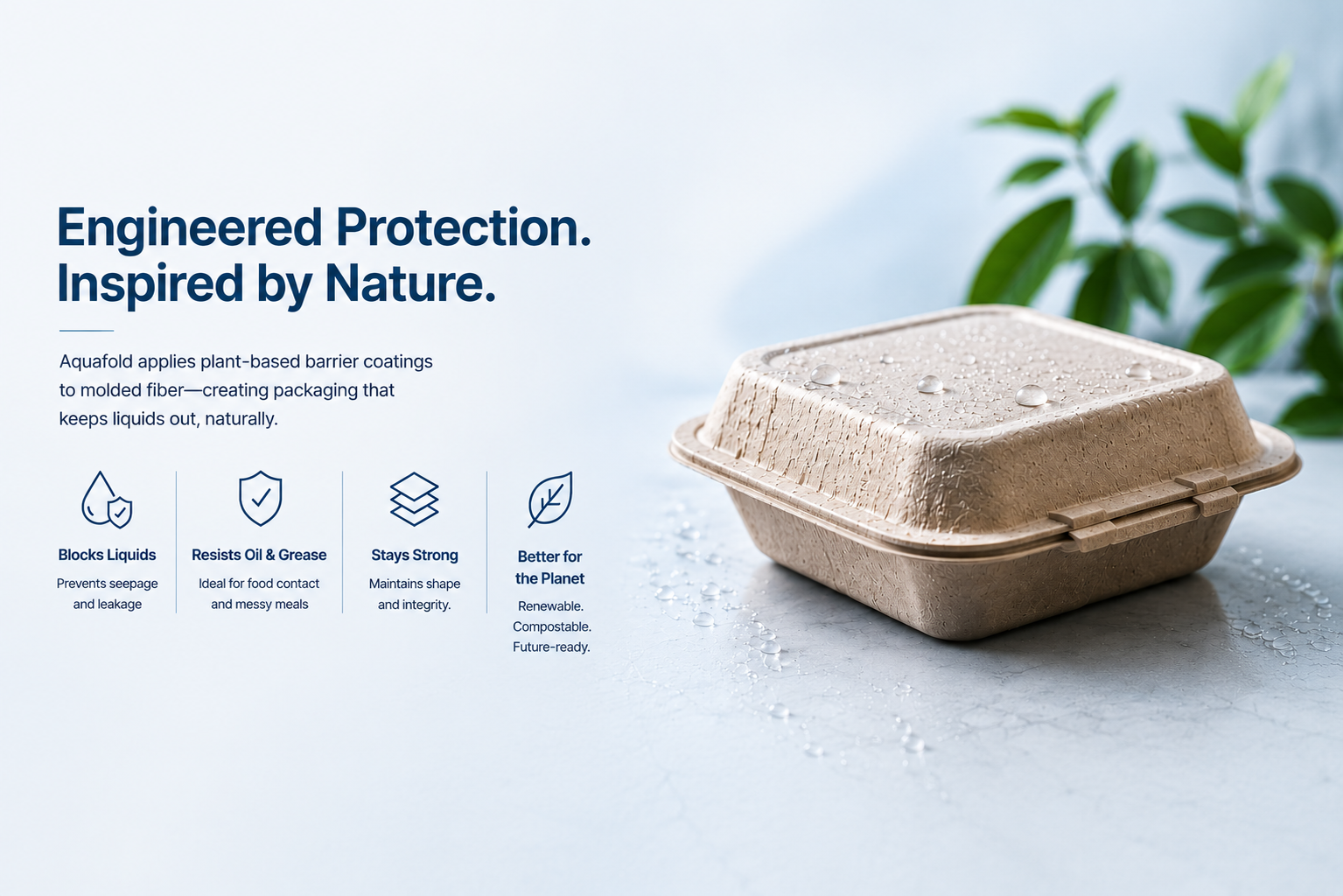
Molded fiber alone is porous — it can't hold liquids without additional treatment. Aquafold applies plant-based barrier coatings to the inner surface of molded fiber products to target:
• Moisture resistance (prevents liquid seepage)
• Oil and grease resistance (suitable for food contact)
• Structural integrity (maintains shape when wet)

Applications Unlocked by Molded Fiber

Molded fiber is not limited to low-performance applications. With proper barrier engineering, it competes directly with plastic in demanding use cases.
• Food-Service Packaging: Plates, bowls, takeout containers, clamshells
• Liquid Packaging: Bottles for water, juice, dairy, beverages
• Cold-Chain Packaging: Insulated containers (future development)
• Protective Packaging: Trays, dividers, cushioning (non-food applications)
The Bottom Line

Molded fiber works because:
• The material is free — agricultural waste, not petroleum
• The technology is mature — pulp molding has been used industrially for decades
• The infrastructure exists — composting and agricultural reintegration
• The policy is aligned — SUP ban, EPR mandates support the switch
• The performance is comparable — with barrier coatings, it meets real-world demands

Aquafold robust packaging